
SKC Blog - Best Heating Systems For Vancouver Island

Efficient, Economical, and Space-Smart Options for 2026
Vancouver Island’s winters are mild compared to the rest of Canada, but they’re also damp and chilly enough that a reliable heating system is essential. The key is finding a system that balances efficiency, economy, and space requirements that performs well in the Island’s coastal climate.
Below, we break down the top heating systems that make sense for homes on Vancouver Island, comparing their costs, energy efficiency, and suitability for different types of homes.
1. Heat Pumps (Air-Source, Ducted, and Ductless)
Overview:
Heat pumps are one of the most popular heating choices on Vancouver Island, and for good reason. Instead of generating heat by burning fuel, they move heat from outside air into your home. Modern air-source heat pumps work efficiently even when outdoor temperatures are near freezing, which fits the Island’s climate perfectly.
Why They’re a Great Fit:
Very high efficiency, often three to four times more efficient than baseboard heaters.
Provide both heating and cooling in one system.
Ideal for the mild winters typical of the Island.
Ductless (mini split) systems are perfect for homes without existing ductwork.
Economy and Space:
Up-front costs are higher than baseboard or basic furnace systems, but energy savings quickly offset that.
Compact indoor and outdoor units make them excellent for smaller homes, townhouses, or retrofits.
Rebates and incentives from BC Hydro and provincial programs can significantly reduce costs.
Best For:
Homeowners who want to reduce monthly heating bills, upgrade older electric systems, or gain air conditioning along with heating.
2. High-Efficiency Gas or Electric Furnaces
Overview:
High-efficiency furnaces remain a solid choice for homes with existing ductwork. Modern models use variable-speed motors and modulating burners to achieve efficiency ratings of up to 98%.
Why They’re a Great Fit:
Familiar technology with predictable operation.
Excellent for larger homes that already have forced-air ducts.
Easier to install if replacing an old furnace with a new high-efficiency unit.
Economy and Space:
Lower initial cost than most heat pump systems.
Operating costs depend on natural gas or electricity prices.
Requires ducting and a small mechanical room or closet.
Best For:
Homes already equipped with ductwork or those connected to natural gas.
3. Ground-Source (Geothermal) or Air-to-Water Systems
Overview:
These systems represent the premium end of residential heating. They use the stable temperature of the ground or outdoor air to heat water, which then circulates through radiant floors or radiators.
Why They’re a Great Fit:
Highest efficiency of all heating options. Often 400–500% efficient.
Extremely low operating costs once installed.
Provide consistent, even heating and excellent comfort.
Economy and Space:
Very high up-front cost and more complex installation.
Require yard space for ground loops (geothermal) or hydronic piping infrastructure.
Best suited to new builds or major renovations.
Best For:
New custom homes or long-term homeowners looking for the most efficient, future-proof option.
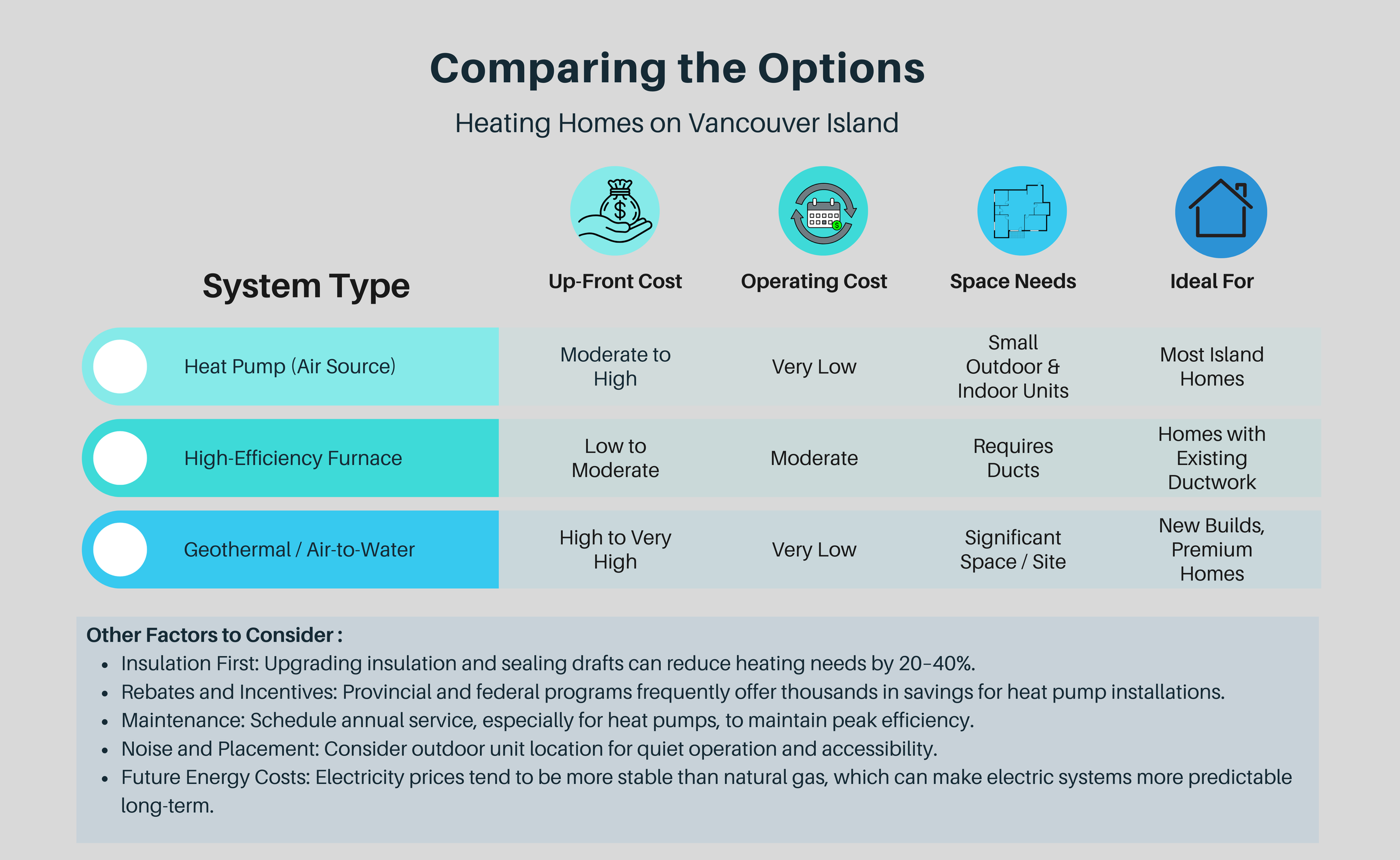
Heating Options Comparisons
The Best All-Around Choice
For most homes on Vancouver Island, the ductless or ducted air-source heat pump is the best overall choice. It offers the lowest running costs, reliable performance in a mild climate, and minimal space requirements.
If you already have a natural gas furnace and aren’t ready for a full upgrade, consider a dual-fuel system, a combination of a gas furnace and a heat pump, which automatically switches to the most efficient energy source depending on temperature.
Final Thoughts
Heating choices on Vancouver Island are all about balance. Because the winters are cool and damp rather than harsh, systems that prioritize efficiency over raw output make the most sense. A modern heat pump or high-efficiency furnace can easily keep your home comfortable while keeping energy costs low.
Before investing, compare total lifetime costs (installation + energy use + maintenance) and explore rebates available in your area. With smart planning, your heating system can deliver both comfort and savings for years to come.